Research
研究以模式识别与机器学习为主线,二十余年的积累串成一条从数据到模型的完整链条:从多元数据分析与可视化起步,进入对抗样本的生成与防御、协同训练与知识蒸馏,最终走向生成模型与数据增强。对抗样本揭示模型的脆弱之处,生成式数据增强则把这种敏感性转化为可用的多样性——两者指向同一个目标:以更优质的数据与更稳健的学习过程,提升模型的鲁棒性与泛化能力。
Research centres on pattern recognition and machine learning, where two decades of work form a single chain from data to model: multivariate data analysis and visualization first, then the generation and defense of adversarial examples, then collaborative training and knowledge distillation, and finally generative models and data augmentation. Adversarial examples expose where a model is fragile; generative data augmentation turns that same sensitivity into usable diversity — both serving one goal: better data and more robust learning, for models that are accurate, resilient and generalizable.
研究领域总览Research Overview
研究领域为模式识别与机器学习,形成四个相互支撑的板块,时间跨度自 2005 年延续至今:
Research centres on pattern recognition and machine learning, organized into four mutually supporting blocks that span from 2005 to the present:
多元数据分析与可视化Multivariate Data Analysis & Visualization
指纹方向场建模;去噪、重建与检索;基于 GLM 与多种重采样方法的高维离散数据统计分析工具包 mvabund,被收录进 CRAN 国际档案大全。Fingerprint orientation-field modelling; denoising, reconstruction and retrieval; the mvabund toolbox for high-dimensional discrete data built on GLM and multiple resampling methods, archived in CRAN.
对抗样本的生成与防御Generating and Defending Adversarial Examples
对抗机器学习(AML)、对抗训练、对抗检索;生物特征隐私保护;查询安全高效的 CBIR 图像检索系统。Adversarial machine learning (AML), adversarial training and adversarial retrieval; biometric privacy protection; query-secure and query-efficient CBIR systems.
协同训练与知识蒸馏Collaborative Training & Knowledge Distillation
联邦学习、模型蒸馏、数据集蒸馏;师生模型与对抗蒸馏。Federated learning, model distillation and dataset distillation; teacher–student models and adversarial distillation.
生成模型与数据增强Generative Models & Data Augmentation
数据增强、参数高效微调(PEFT);GAN、自回归 Transformer 与扩散模型驱动的数据生成。Data augmentation and parameter-efficient fine-tuning (PEFT); data generation driven by GANs, autoregressive Transformers and diffusion models.
Ⅰ · 对抗样本的生成与防御Ⅰ · Generating and Defending Adversarial Examples
对抗机器学习Adversarial Machine Learning
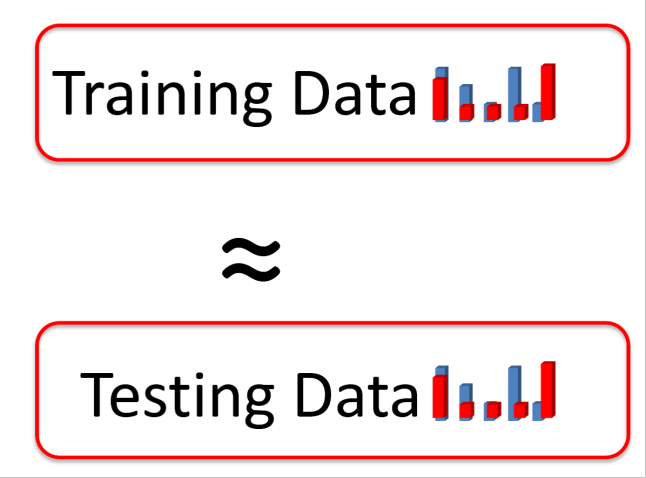
传统机器学习建立在“静态环境”的平稳性假设之上;真实开放环境打破这一假设,攻击者可通过数据投毒、白盒攻击、黑盒攻击与绕过检测等手段破坏模型。
Classical machine learning rests on a stationarity assumption about a static environment. Real open-world deployment breaks that assumption: attackers can poison data, mount white-box or black-box attacks, or bypass detection.
- 平稳性假设:训练/测试数据独立同分布,统计特性不随时间改变。
- 该假设支撑:模型有效性、预测可靠性、统计检验性。
- 开放环境:对抗样本的生成与防御成为模型落地的必要环节。
- Stationarity assumption: training and test data are i.i.d., and statistical properties do not drift over time.
- What it underpins: model validity, prediction reliability and statistical testability.
- Open environment: generating and defending adversarial examples becomes indispensable for deployment.
基于内容查询的图像检索攻击Attacking Content-Based Image Retrieval
针对 CBIR 系统提出一种自适应的决策型黑盒算法,大幅减少 87% 的系统查询次数,并在微软必应 Bing 等商业检索引擎上展示了攻击有效性:原始图像的检索结果(如 wardrobe)被对抗样本整体改写为 tapestry、painting、tiles 等无关结果。
For CBIR systems we propose an adaptive decision-based black-box algorithm that cuts system queries by 87%, and demonstrate its effectiveness on commercial engines such as Microsoft Bing: the original retrieval results (e.g. wardrobe) are rewritten by an adversarial sample into unrelated results such as tapestry, painting and tiles.
- 查询高效:决策型黑盒设定下大幅压缩查询预算。
- 真实可用:在商业视觉检索(Bing 相似图片)上验证。
- 面向检索:攻击目标是 top-K 检索结果,而非单一分类标签。
- Query-efficient: sharply reducing the query budget under a decision-based black-box setting.
- Practically valid: verified on a commercial visual search engine (Bing Similar Images).
- Retrieval-oriented: the target is the top-K retrieved set, not a single class label.

联邦学习中的数据重构与隐私泄露Data Reconstruction and Privacy Leakage in Federated Learning
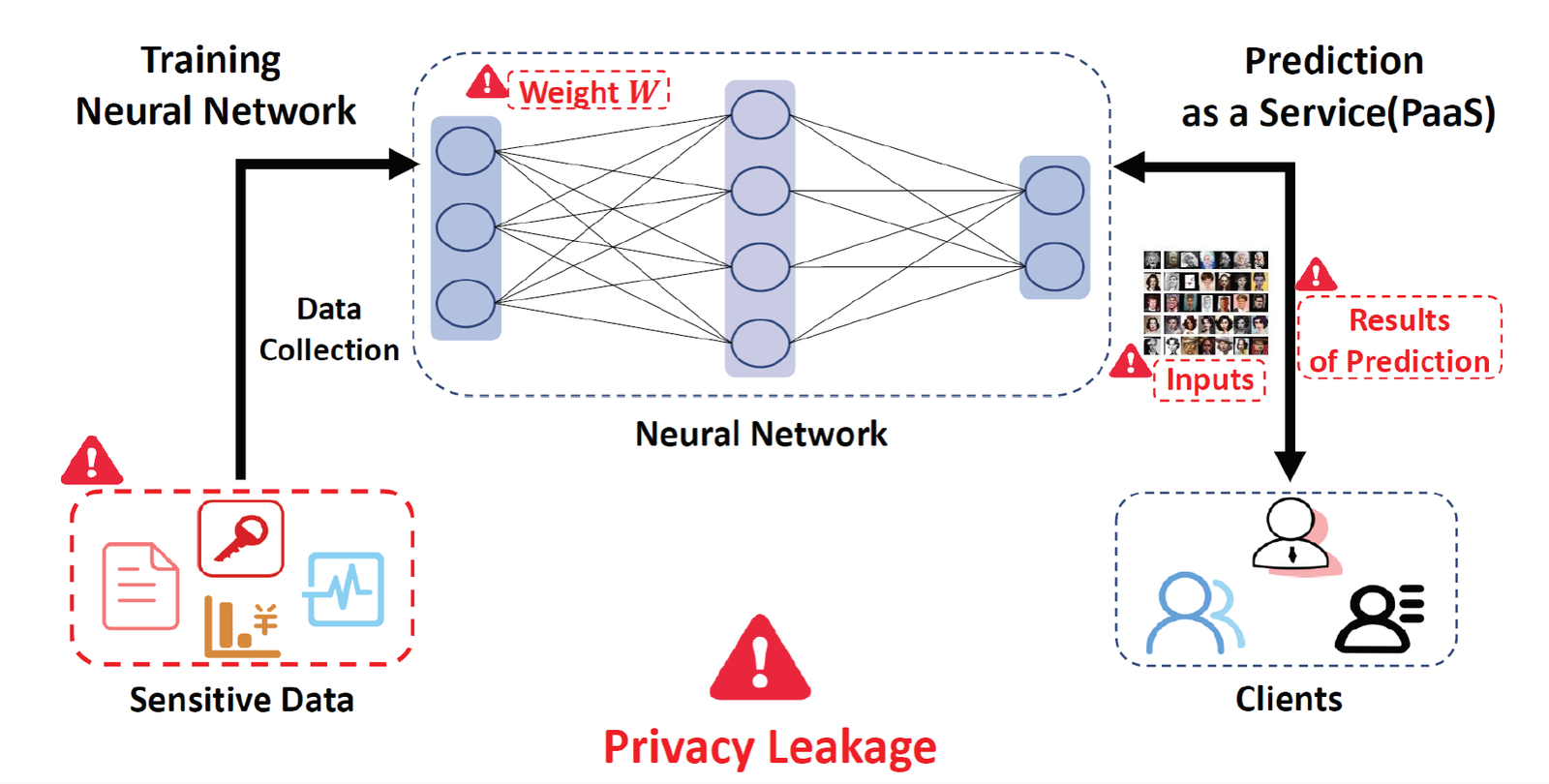
根据客户端上传到服务器的信息,对其本地数据集实施隐私保护攻击,包括样本重构、参数泄漏、成员推断与属性推断等。
From the information clients upload to the server, we mount privacy attacks on their local datasets — sample reconstruction, parameter leakage, membership inference and property inference.
- 揭示了协同学习中“共享参数”并不等于“共享安全”。
- 在深度特征空间对客户端本地数据集进行属性推断。
- 给出客户端样本重构的准确率比较,量化泄露风险。
- Shows that sharing parameters in collaborative learning is not the same as sharing safety.
- Performs property inference on a client’s local dataset in deep feature space.
- Reports client-side sample reconstruction accuracy to quantify the leakage risk.
集成深度模型的对抗稳健性Adversarial Robustness of Deep Ensembles
基模型高层特征的多样化表示可以显著提升集成深度学习模型的对抗稳健性,据此提出优先多样化 Dropout(PDD)与分散式集成梯度(DEG)。
Diversified high-level feature representations across base networks markedly improve the adversarial robustness of deep ensembles — realized as Priority Diversified Dropout (PDD) and Dispersed Ensemble Gradients (DEG).
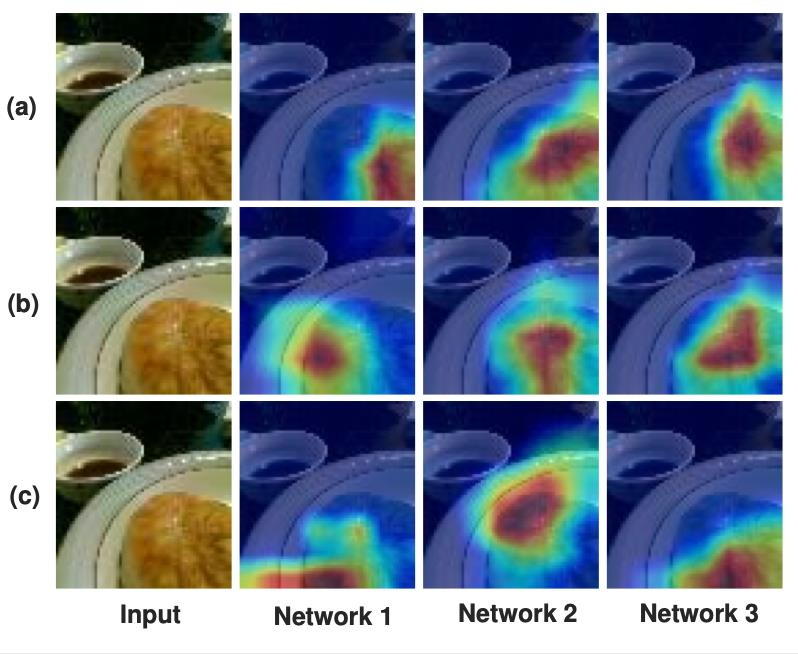
- 以 Grad-CAM 可视化对比基线、ADP 与 PDD 下各基网络对最后一层 FC 的关注区域。
- CIFAR-100 上 2000 张测试图像的平均判别分数箱线图:分数越高,基网络间 FC 特征差异越大(K = 3)。
- Grad-CAM comparison of the last fully-connected layer for each base network under baseline, ADP and PDD.
- Box-plots of the average discrimination score over 2000 CIFAR-100 test images — a higher value means larger FC-feature divergence among base networks (K = 3).
Ⅱ · 协同训练与知识蒸馏Ⅱ · Collaborative Training and Knowledge Distillation
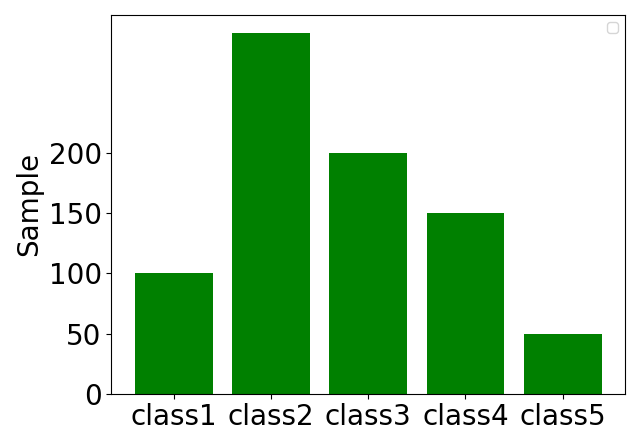
该方向关注的核心矛盾是:多客户端长尾数据导致协作偏差并影响收敛。研究围绕隐私—效用与通信效率、模型鲁棒性与泛化能力、多模态表征对齐与多路编码器融合、多场景应用下的模型泛化与自适应能力展开。
The central tension: long-tailed data across many clients induces collaboration bias and hurts convergence. Research addresses privacy–utility and communication efficiency, model robustness and generalization, multimodal representation alignment and multi-encoder fusion, and cross-scenario generalization and adaptivity.
联邦蒸馏解决长尾数据分布导致的协作偏差Federated Distillation against Long-Tailed Collaboration Bias
多客户端数据呈现长尾分布(Non-IID),带来安全隐私保护、客户端过拟合、收敛慢且不稳定、策略异质性四类挑战;以“联邦蒸馏 + 数据增强”应对:基于实例的自然采样与基于类别的均衡采样协同,在服务器端优化聚合与平滑统计,并对分类器偏差进行校准。
Client data are long-tailed (Non-IID), raising four challenges — privacy protection, client over-fitting, slow and unstable convergence, and strategy heterogeneity. The answer is federated distillation plus data augmentation: instance-based natural sampling combined with class-based balanced sampling, server-side optimization of aggregation and smoothed statistics, and calibration of classifier bias.
- 更适合表示学习的采样与更适合分类器学习的采样互补。
- 针对分类器偏差与泛化能力不足进行显式校准。
- Samples better suited to representation learning complement those better suited to classifier learning.
- Explicit calibration against classifier bias and limited generalization.
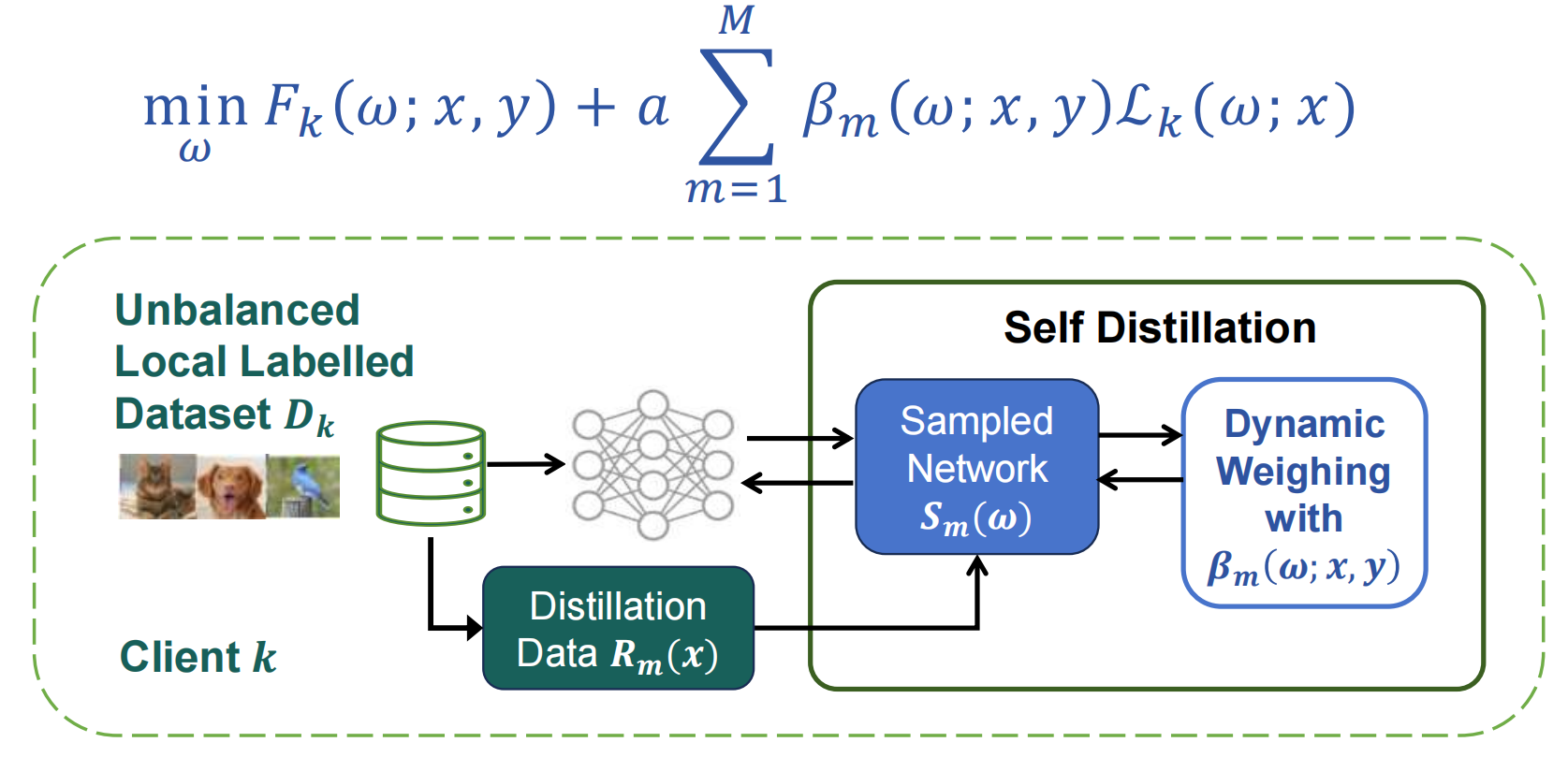
客户端自蒸馏Client Self-Distillation
通过引入随机变换生成的蒸馏数据,并结合多个子网络的软标签对齐(Logits Transfer),增强模型内部知识多样性,抑制本地过拟合。
Randomly transformed distillation data, combined with soft-label alignment (logits transfer) across multiple sub-networks, strengthens intra-model knowledge diversity and suppresses local over-fitting.
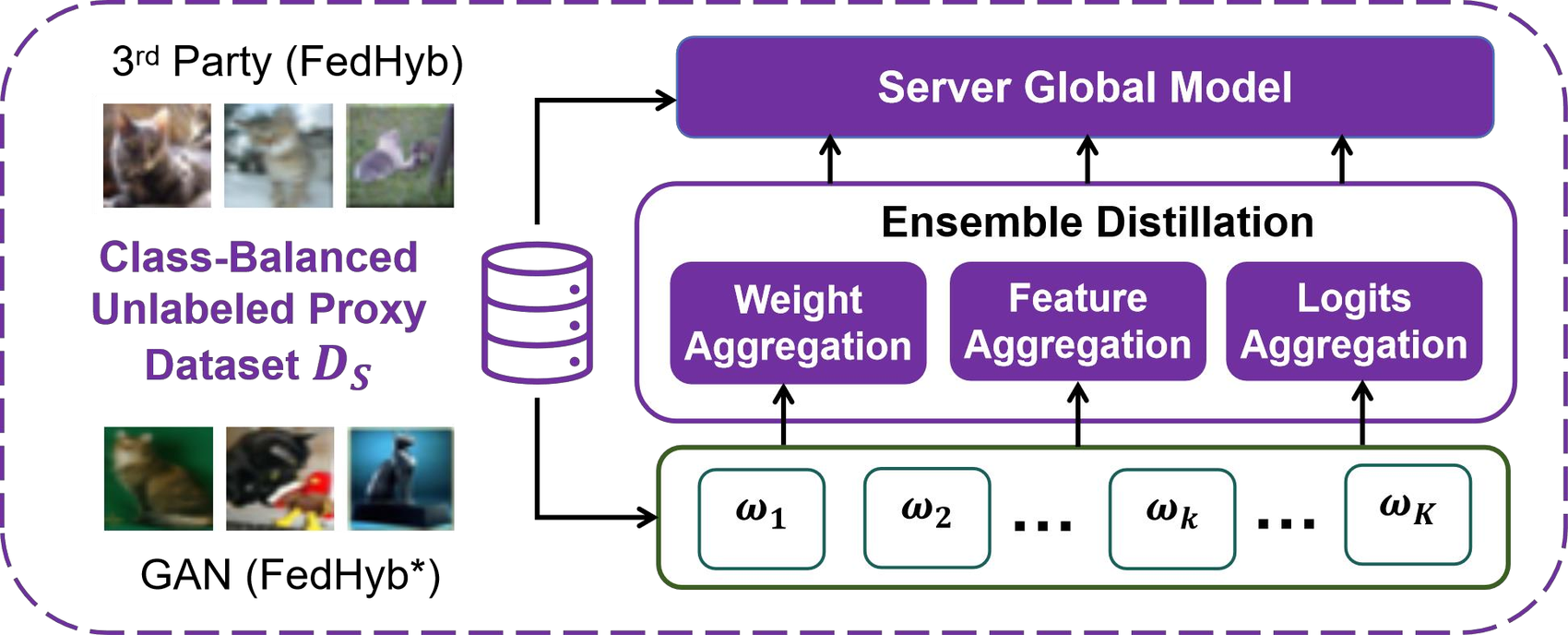
服务器集成蒸馏Server Ensemble Distillation
通过类别均衡的第三方无标签代理数据集引导多方位知识迁移,对齐师生模型在其上的特征表示与软标签;三重对齐模型权重、特征表示与软标签输出,学习更紧凑的特征并优化损失空间结构,提升全局模型的鲁棒性和泛化能力。
A class-balanced, third-party unlabeled proxy dataset steers multi-faceted knowledge transfer, aligning teacher and student representations and soft labels on it. Triple alignment — model weights, feature representations and soft-label outputs — yields more compact features and a better-structured loss space, improving global robustness and generalization.
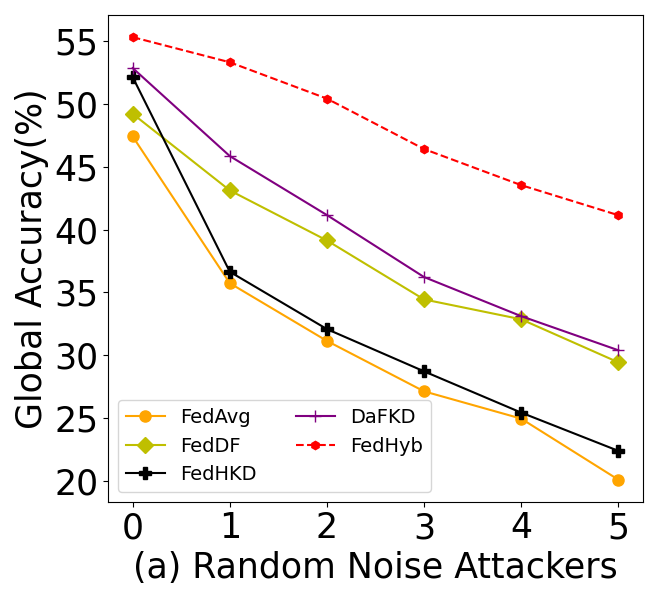
突破联邦学习在长尾异构下的性能瓶颈Breaking the Long-Tailed Heterogeneity Bottleneck
在不同数据异质性指标 α 与长尾分布指标 IF 下,所提方法在 SVHN、CIFAR-10 以及医学影像基准数据集 CheXpert 上均取得更高的全局测试准确率。
Across data-heterogeneity level α and long-tail indicator IF, the method achieves higher global test accuracy on SVHN, CIFAR-10 and the medical imaging benchmark CheXpert.
- 达到目标精度所需的通信轮次显著减少。
- 对恶意客户端下的毒攻击更鲁棒(随机噪声攻击、拜占庭攻击)。
- Markedly fewer communication rounds to reach a target accuracy.
- More robust to poisoning by malicious clients (random-noise and Byzantine attacks).
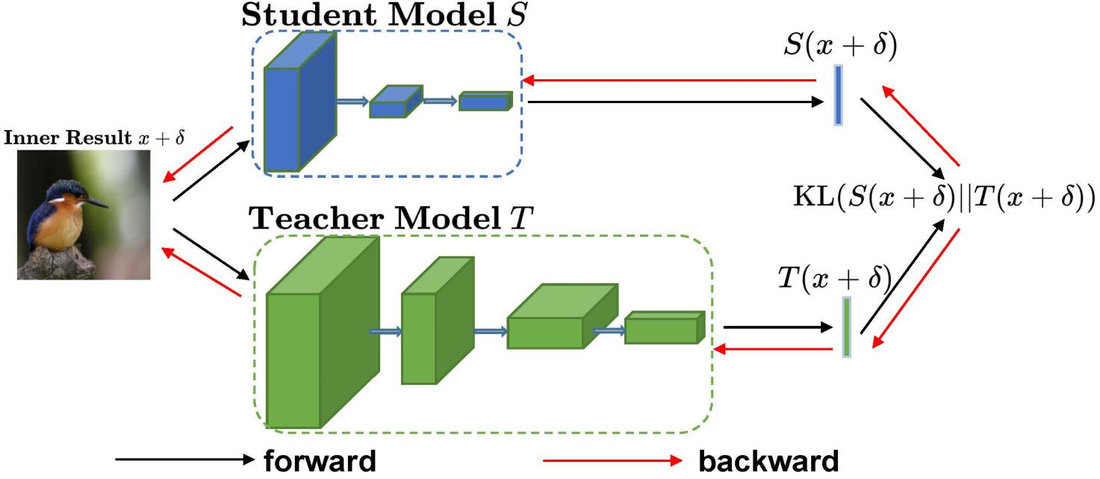
自适应的对抗蒸馏法(AdaAD)Adaptive Adversarial Distillation (AdaAD)
传统对抗训练在小容量学生模型上提升鲁棒性并不理想,常出现精度与鲁棒性失衡。AdaAD 在对抗博弈框架下优化大小模型之间的蒸馏过程:模拟近似推导二者的最大点对点对齐关系,在内部优化中自适应搜索最优匹配点(锚点),通过小模型生成对抗训练数据以增加大小模型间互动,并设计新的对抗蒸馏目标。
Conventional adversarial training struggles on small-capacity students, often trading accuracy for robustness. AdaAD optimizes teacher–student distillation inside an adversarial-game framework: it derives the maximal point-to-point alignment between the two models, adaptively searches for the best anchor during inner optimization, generates adversarial training data through the student to increase interaction, and designs a new adversarial distillation objective.
Ⅲ · 生成模型与数据增强Ⅲ · Generative Models and Data Augmentation
图像生成模型Image Generation Models
涵盖生成式对抗网络 GAN、自回归 Transformer 与 Diffusion 扩散模型三条技术路线,面向四类需求:满足小样本学习、符合常理和常识、减少算力和内存、具备局部编辑可控性——即可靠、鲁棒、高效。
Three technical routes — GANs, autoregressive Transformers and diffusion models — serve four requirements: few-shot capability, commonsense plausibility, reduced compute and memory, and controllable local editing, i.e. reliable, robust and efficient generation.
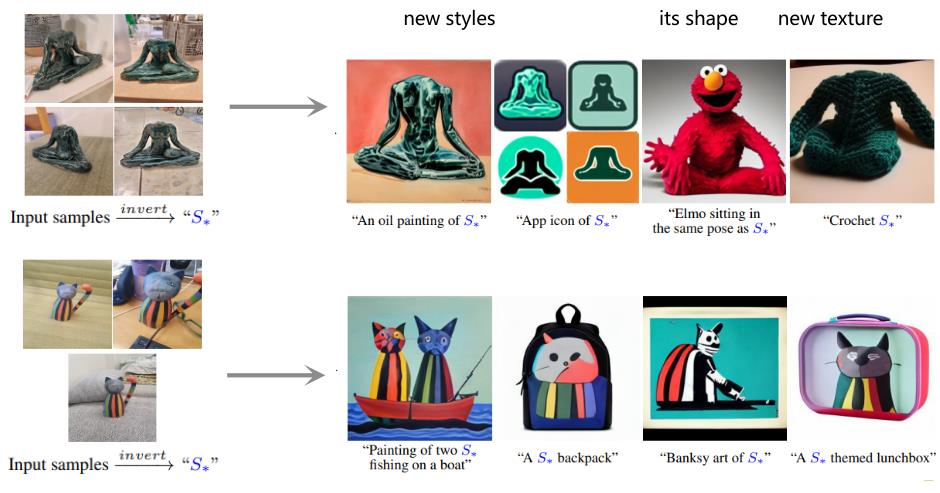
生成式数据增强:对抗数据增强Generative Augmentation: Adversarial Data Augmentation
在主网络中插入鲁棒特征适配器(RFA),通过在特征空间动态自适应生成对抗扰动,有效解决传统对抗训练计算开销大和鲁棒过拟合的问题;推理阶段插拔 RFA 适配器还可用于对抗检测。
A Robustness Feature Adapter (RFA) inserted into the main network dynamically generates adversarial perturbations in feature space, solving the high computational cost and robust over-fitting of conventional adversarial training; the adapter can be plugged in or out at inference for adversarial detection.
- ViT 对抗训练效率提升 4 倍以上。
- 模型复杂度增加不足 1/10,鲁棒性增益可超过 50%。
- Over 4× faster adversarial training for ViT.
- Less than 1/10 added model complexity, with robustness gains above 50%.
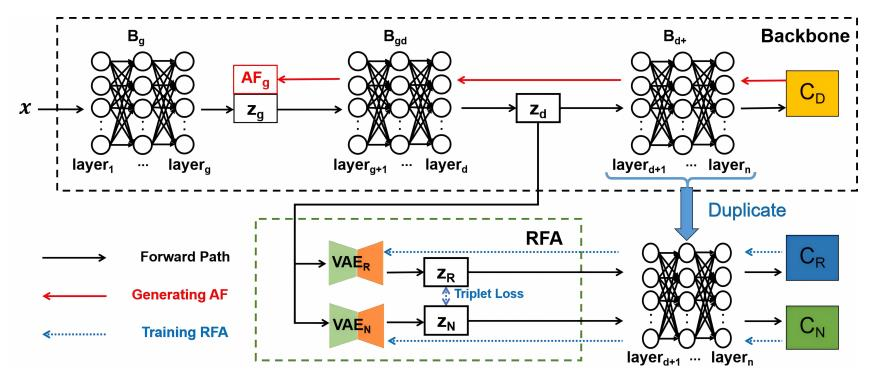
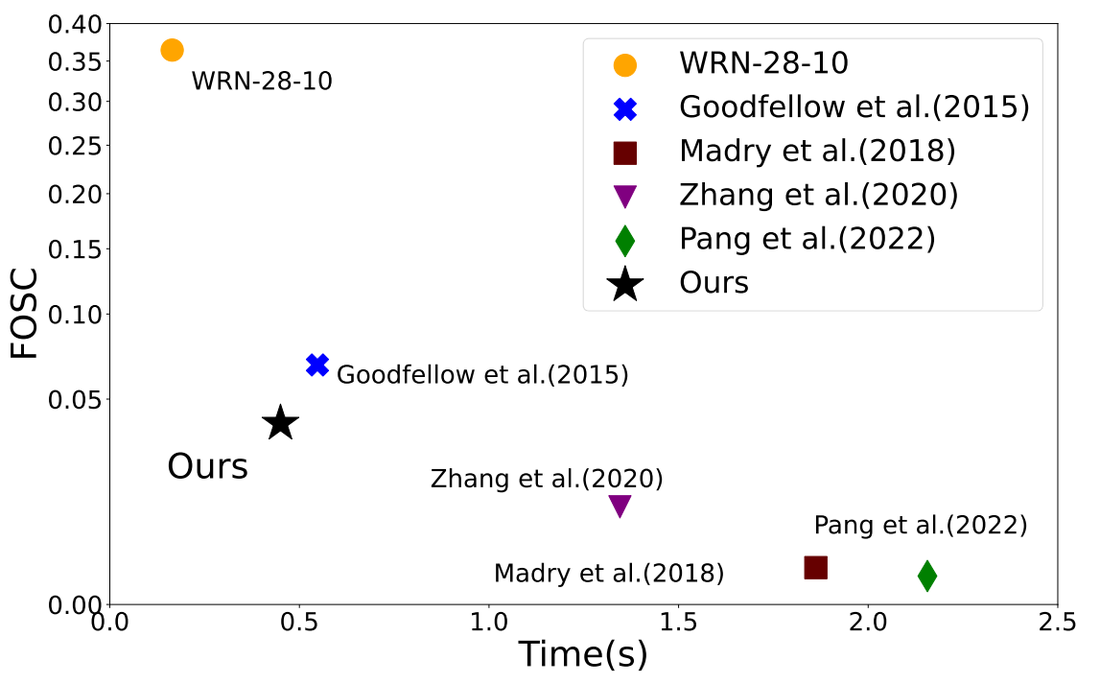
“插件式”RFA 对抗训练的收敛质量与效率Convergence Quality and Efficiency of Plug-in RFA
从效率与收敛质量两方面评估 RFA:仅更新适配器参数即可显著降低计算开销,尤其适用于大规模预训练模型(如 ViT)的对抗训练;尽管训练速度快,仍能保持较低的 FOSC 值,说明生成的对抗样本质量高,有助于提升鲁棒性泛化能力。该结构亦可迁移至个性化联邦学习,同时增强客户端对抗鲁棒性。
RFA is evaluated on both efficiency and convergence quality: updating only adapter parameters sharply cuts computation, especially for large pre-trained models such as ViT; despite fast training it maintains a low FOSC value, indicating high-quality adversarial examples that improve robustness generalization. The same design transfers to personalized federated learning while strengthening client-side adversarial robustness.
生成式数据增强:自适应下游多任务模型Generative Augmentation: Adapting to Downstream Multi-Task Models
情景自适应的数据增强(IGD)在推理阶段利用外部约束(目标梯度),引导反向扩散过程动态自适应地生成能够等效训练下游任务模型的代理数据集,实现生成模型免微调、高效率地控制反向去噪过程。
Scene-adaptive data augmentation (IGD) uses external constraints — target gradients — at inference time to steer the reverse diffusion process, dynamically generating a proxy dataset that can equivalently train downstream models. The generative model needs no fine-tuning, and the reverse denoising process is controlled efficiently.
- 设计自定义的外部属性梯度作为引导函数。
- 在反向去噪的推断采样阶段施加定向吸引力或排斥力。
- 引导生成过程自适应下游任务目标,避免昂贵的生成模型重训练。
- A custom external attribute gradient serves as the guidance function.
- Directed attraction or repulsion is applied during inference-time reverse denoising.
- Generation adapts to the downstream objective, avoiding costly retraining of the generator.

生成式数据增强:数据蒸馏代表性样本Generative Augmentation: Representative Samples via Data Distillation
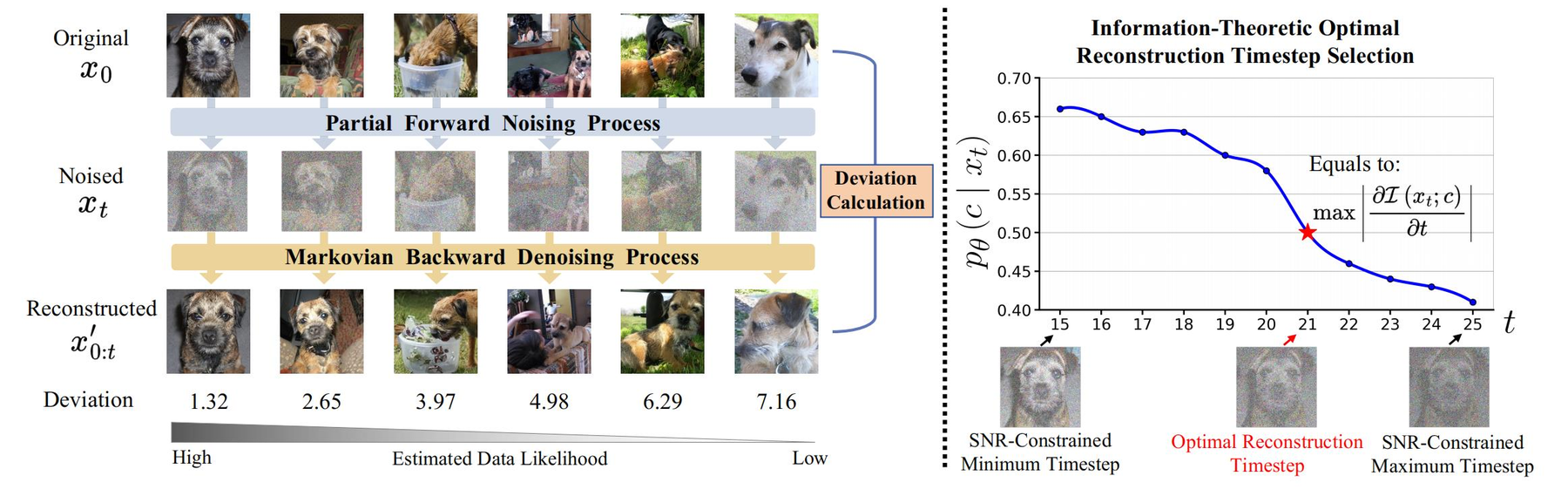
核心数据集蒸馏法(Core-Set Selection)将大型真实数据集的核心知识提炼到小规模合成或筛选数据集,可用于持续/增量学习与边缘设备部署;通过 DDPM 部分逆去噪过程中引发的重建偏差,反映并量化潜在的数据似然度。
Core-set selection distils the core knowledge of a large real dataset into a small synthesized or selected set, serving continual/incremental learning and edge deployment. Reconstruction bias induced by partial reverse denoising in DDPM reflects and quantifies the underlying data likelihood.
- 高似然样本:重构偏差小。
- 低似然样本:语义变化、视觉显著性下降。
- 选择最优重建时刻 t,使目标落在给定区间内。
- High-likelihood samples: small reconstruction bias.
- Low-likelihood samples: semantic drift and declining visual saliency.
- Select the optimal reconstruction step t so that the target falls within the required interval.
生成式数据增强:多模态医学图像融合Generative Augmentation: Multimodal Medical Image Fusion
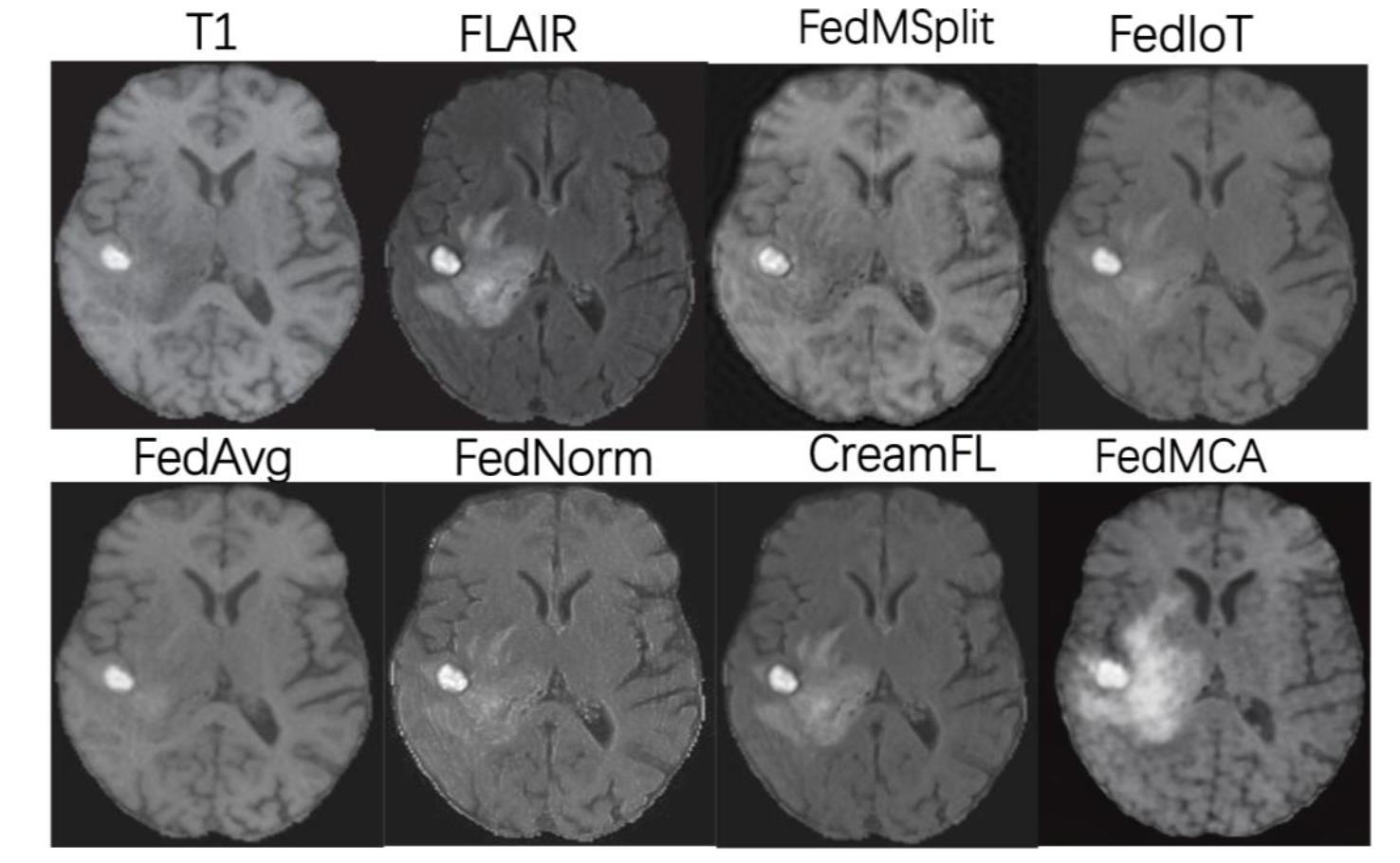
通过多模态特征融合与分布对齐的协同优化,提高模型对复杂异构数据的表征能力,从而提升整体预测精度。
Coordinated multimodal feature fusion and distribution alignment strengthen the model’s representation of complex heterogeneous data, raising overall predictive accuracy.
生成式数据增强:单轮通信的联邦学习Generative Augmentation: One-Shot Communication Federated Learning
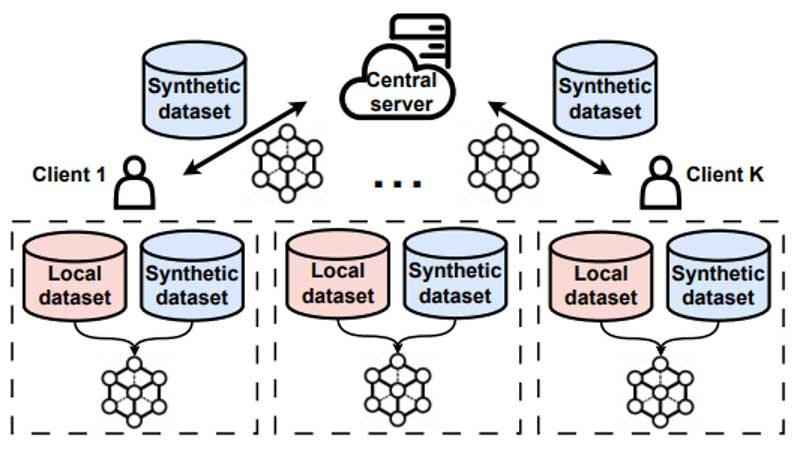
数据生成阶段基于对抗博弈的多专家蒸馏融合客户端编码器;模型蒸馏阶段将融合后的集成编码器知识蒸馏到全局模型。由此服务器可通过单轮通信学习全局模型,有效降低客户端的通信成本与安全风险。
In the data-generation stage, multi-expert distillation under an adversarial game fuses client encoders; in the model-distillation stage, the fused ensemble-encoder knowledge is distilled into the global model. The server can therefore learn a global model in a single communication round, cutting client communication cost and security risk.
- 无需额外信息交换:只需在客户端与服务器之间传输模型参数。
- 无需辅助数据集(data-free):服务器不需要额外的训练数据。
- 考虑模型异质性:适应不同客户端拥有不同的模型架构。
- No extra information exchange: only model parameters travel between clients and server.
- No auxiliary dataset (data-free): the server needs no additional training data.
- Model heterogeneity aware: accommodates clients with different architectures.
生成式数据增强:探索超材料结构Generative Augmentation: Exploring Metamaterial Structures
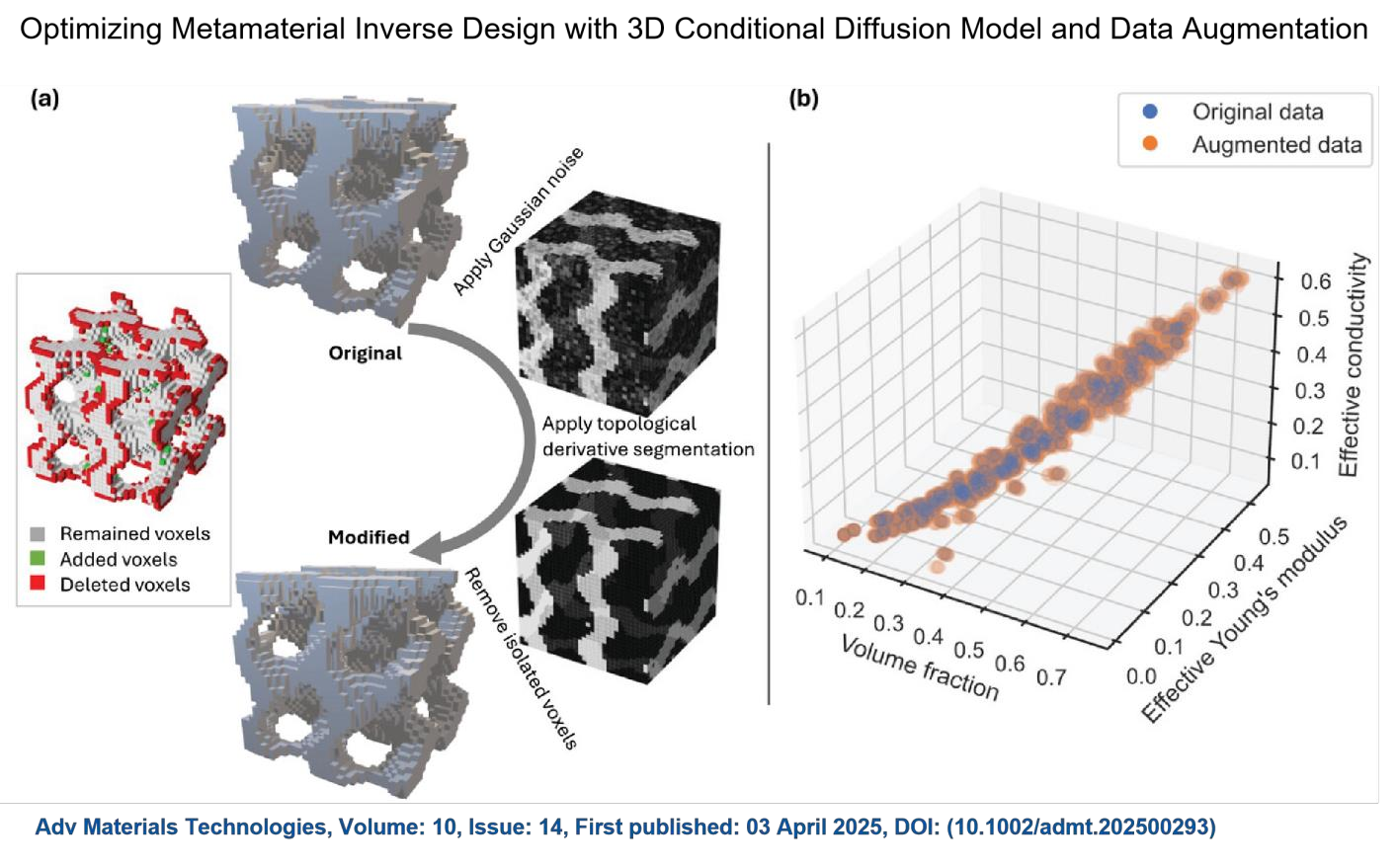
早期设计依赖人工专业经验与手动设计。超材料具有可编程几何结构,可通过设计几何结构定制特定功能;研究基于体素化表示构建几何候选体结构,并在生成过程中平衡合理性、新颖性与多样性。
Early design relied on expert experience and manual effort. Metamaterials have programmable geometry, so specific functions can be tailored by designing that geometry. Candidates are built on voxelized representations, with generation balancing plausibility, novelty and diversity.
总结:从对抗样本到生成式数据增强Summary: From Adversarial Examples to Generative Data Augmentation
两条路线共享同一套底层机制——学习数据空间中的有效扰动、利用高维空间的“线性敏感性”,最终都服务于模型的鲁棒性与泛化能力;差别在于扰动的目标与约束。
Both routes share the same underlying mechanisms — learning effective perturbations in data space and exploiting the linear sensitivity of high-dimensional space — and both ultimately serve robustness and generalization. They differ in the objective and constraints placed on the perturbation.
| 维度Dimension | 对抗样本Adversarial examples | 生成式数据增强Generative data augmentation |
|---|---|---|
| 扰动目标Perturbation goal | 约束条件下的定向扰动生成,目标“破坏模型性能”Constrained, targeted perturbation aimed at breaking model performance | 分布约束下的自然扰动生成,目标“保持语义、增加变化”Distribution-constrained, natural perturbation aimed at preserving semantics while adding variation |
| 高维线性敏感性Linear sensitivity | 定向累积扰动以实现错误分类Accumulating targeted perturbations to force misclassification | 微小扰动不改变语义,仅增加多样性Small perturbations that leave semantics intact and add diversity |
| 对模型的价值Value to the model | 通过对抗训练暴露模型脆弱点,学会应对攻击(安全威胁)Adversarial training exposes vulnerabilities so the model learns to resist attacks (security threats) | 通过补充训练数据覆盖更多场景,缓解数据稀缺与分布偏移Supplementary training data cover more scenarios, relieving data scarcity and distribution shift |
从对抗样本到生成式数据增强From adversarial examples to generative data augmentation
Research | 研究方向
模式识别:从对抗样本到生成式数据增强 Pattern Recognition: From Adversarial Examples to Generative Data Augmentation
研究以模式识别与机器学习为主线,自 2005 年延续至今:从多元数据分析与可视化起步,进入对抗样本的生成与防御、协同训练与知识蒸馏,最终走向生成模型与数据增强。对抗样本揭示模型的脆弱之处,生成式数据增强把这种敏感性转化为可用的多样性——两者共同指向同一个目标:以更优质的数据与更稳健的学习过程,提升模型的鲁棒性与泛化能力。
The research follows a single line — pattern recognition and machine learning — from 2005 to the present: it starts with multivariate data analysis and visualisation, moves into the generation and defense of adversarial examples and into collaborative training with knowledge distillation, and arrives at generative models and data augmentation. Adversarial examples expose where a model is fragile; generative data augmentation turns that same sensitivity into usable diversity. Both serve one goal: better data and more robust learning, for models that are accurate, resilient and generalisable.
研究领域总览Research Overview
研究领域为模式识别与机器学习。二十余年的工作形成四个相互支撑的板块,时间跨度自 2005 年延续至今:
The research area is pattern recognition and machine learning. Two decades of work form four mutually supporting blocks, spanning 2005 to the present:
| 板块Block | 核心内容Focus |
|---|---|
| 多元数据分析与可视化Multivariate data analysis & visualisation | 指纹方向场建模;去噪、重建、检索、查询;基于 GLM 与多种重采样方法的高维离散数据统计分析工具包 mvabund,被收录进 CRAN 国际档案大全Fingerprint orientation-field modelling; denoising, reconstruction, retrieval and query; mvabund, a toolbox for high-dimensional discrete data built on GLM with multiple resampling methods, archived in CRAN |
| 对抗样本攻击与防御Attacks and defenses on adversarial examples | 对抗机器学习(AML);生物特征隐私保护;安全高效的 CBIR 图像检索系统Adversarial machine learning (AML); biometric privacy protection; secure and query-efficient CBIR systems |
| 协同训练与知识蒸馏Collaborative training & knowledge distillation | 联邦学习、模型蒸馏、数据集蒸馏Federated learning, model distillation and dataset distillation |
| 生成模型与适配器Generative models & adapters | 数据增强、参数高效微调(PEFT)Data augmentation and parameter-efficient fine-tuning (PEFT) |
Ⅰ · 对抗样本的生成与防御Ⅰ · Generating and Defending Adversarial Examples
该方向覆盖对抗机器学习、对抗训练与对抗检索:从传统学习的平稳性假设出发,给出对抗样本的生成方法、联邦学习中的隐私泄露路径,以及提升集成模型对抗稳健性的途径。
This direction covers adversarial machine learning, adversarial training and adversarial retrieval: starting from the stationarity assumption of classical learning, it presents how adversarial examples are generated, how privacy leaks in federated learning, and how the robustness of deep ensembles can be improved.
对抗机器学习Adversarial Machine Learning
静态环境下的平稳性假设是传统机器学习的前提:训练/测试数据独立同分布,统计特性不随时间改变,模型有效性、预测可靠性与统计检验性由此成立。开放环境下,白盒攻击、黑盒攻击、绕过检测与数据投毒使这一假设失效,对抗样本的生成与防御因此成为模型落地的必要环节。
Stationarity in a static environment underpins classical machine learning: training and test data are independent and identically distributed, and statistical properties do not drift, so model validity, prediction reliability and statistical testability hold. In an open environment, white-box attacks, black-box attacks, detection bypassing and data poisoning break that assumption — generating and defending adversarial examples becomes indispensable for deployment.
- 静态环境下的平稳性假设:训练/测试数据独立同分布;统计特性不随时间改变。
- 该假设支撑:模型有效性、预测可靠性与统计检验性。
- 开放环境下的对抗样本生成与防御:白盒攻击、黑盒攻击、绕过检测、数据投毒。
- Stationarity in a static environment: training and test data are i.i.d., and statistical properties do not drift over time.
- What it underpins: model validity, prediction reliability and statistical testability.
- In an open environment, adversarial examples are generated and defended against: white-box attacks, black-box attacks, detection bypassing and data poisoning.
基于内容查询的图像检索攻击Attacking Content-Based Image Retrieval
针对 CBIR 系统提出一种自适应的决策型黑盒算法,大幅减少 87% 的系统查询次数,并成功在微软必应 Bing 等商业检索引擎上展示了攻击有效性:原始检索结果(wardrobe)被对抗检索样本改写为 tapestry、painting、tiles 等无关结果。
For CBIR systems we propose an adaptive decision-based black-box algorithm that cuts system queries by 87%, and we demonstrate its effectiveness on commercial engines such as Microsoft Bing: the original retrieval results (wardrobe) are rewritten by an adversarial retrieval sample into unrelated results such as tapestry, painting and tiles.
联邦学习中的数据重构与隐私泄露Data Reconstruction and Privacy Leakage in Federated Learning
根据客户端上传到服务器的信息,对其本地数据集实施隐私保护攻击,包括样本重构、参数泄漏、成员推断、属性推断等。
From the information that clients upload to the server, privacy attacks are mounted on their local datasets — sample reconstruction, parameter leakage, membership inference and property inference.
- 对客户端的本地数据集进行属性推断。
- 给出客户端样本重构的准确率比较。
- Property inference on a client’s local dataset.
- Accuracy comparison of client-side sample reconstruction.
集成深度模型的对抗稳健性Adversarial Robustness of Deep Ensembles
基模型高层特征的多样化表示可以显著提升集成深度学习模型的对抗稳健性,据此提出优先多样化 Dropout(Priority Diversified Dropout, PDD)与分散式集成梯度(Dispersed Ensemble Gradients, DEG)。
Diversified high-level feature representations across base networks markedly improve the adversarial robustness of deep ensembles, realised as Priority Diversified Dropout (PDD) and Dispersed Ensemble Gradients (DEG).
- PDD:优先多样化 Dropout,促使各基网络学习差异化的高层特征。
- DEG:分散式集成梯度,抑制基网络梯度同质化。
- CIFAR-100 上 2000 张测试图像的平均判别分数箱线图(K = 3):分数越高,基网络间 FC 特征差异越大。
- Grad-CAM 对比各基网络最后一层 FC 的关注区域:(a) 基线、(b) ADP、(c) PDD。
- PDD: priority diversified dropout, pushing base networks towards differentiated high-level features.
- DEG: dispersed ensemble gradients, countering gradient homogenisation across base networks.
- Box-plots of the average discrimination score over 2000 CIFAR-100 test images (K = 3): a higher value means larger FC-feature divergence between base networks.
- Grad-CAM comparison of the last FC layer of each base network: (a) baseline, (b) ADP, (c) PDD.
Ⅱ · 协同训练与知识蒸馏Ⅱ · Collaborative Training and Knowledge Distillation
该方向围绕联邦学习、师生模型、模型蒸馏与对抗蒸馏展开,核心矛盾是:多客户端长尾数据导致协作偏差并影响收敛。研究关注模型鲁棒性与泛化能力、隐私—效用与通信效率、多模态表征对齐与多路编码器融合策略,以及多场景应用下的模型泛化与自适应能力。
This direction covers federated learning, teacher–student models, model distillation and adversarial distillation. The central tension: long-tailed data across many clients induces collaboration bias and hurts convergence. The work addresses model robustness and generalisation, privacy–utility and communication efficiency, multimodal representation alignment with multi-encoder fusion, and cross-scenario generalisation and adaptivity.
联邦蒸馏解决长尾数据分布导致的协作偏差Federated Distillation against Long-Tailed Collaboration Bias
多客户端数据呈现长尾分布(Non-IID),带来安全隐私保护、客户端过拟合、收敛慢且不稳定等问题,并造成分类器偏差与泛化能力不足。应对之道是“联邦蒸馏 + 数据增强”:基于实例的自然采样(更适合表示学习)与基于类别的均衡采样(更适合分类器学习)互补,联邦蒸馏优化聚合策略,数据增强平滑统计异质性,并对分类器偏差进行校准。
Client data are long-tailed (non-IID), raising privacy protection, client over-fitting, and slow or unstable convergence, and producing classifier bias with limited generalisation. The answer is federated distillation plus data augmentation: instance-based natural sampling (better suited to representation learning) complements class-based balanced sampling (better suited to classifier learning); federated distillation optimises the aggregation strategy, data augmentation smooths statistical heterogeneity, and classifier bias is calibrated.
- 长尾 Non-IID 带来的问题:安全隐私保护、客户端过拟合、收敛慢不稳定。
- 后果:分类器偏差、泛化能力不足。
- 应对:联邦蒸馏优化聚合策略;数据增强平滑统计异质性;两类采样互补;对分类器偏差进行校准。
- Challenges of long-tailed non-IID data: privacy protection, client over-fitting, slow and unstable convergence.
- Consequences: classifier bias and limited generalisation.
- Response: federated distillation optimises aggregation; data augmentation smooths statistical heterogeneity; the two sampling schemes complement each other; classifier bias is calibrated.
客户端自蒸馏Client Self-Distillation
通过引入随机变换生成的蒸馏数据,并结合多个子网络的软标签对齐(Logits Transfer),增强模型内部知识多样性,抑制本地过拟合。
Distillation data produced by random transformations, combined with soft-label alignment (logits transfer) across multiple sub-networks, strengthens intra-model knowledge diversity and suppresses local over-fitting.
服务器集成蒸馏Server Ensemble Distillation
通过类别均衡的第三方无标签代理数据集引导多方位知识迁移,对齐师生模型在其上的特征表示与软标签。三重对齐模型权重、特征表示与软标签输出,学习更紧凑的特征并优化损失空间结构,提升全局模型的鲁棒性和泛化能力。
A class-balanced, third-party unlabeled proxy dataset steers multi-faceted knowledge transfer, aligning teacher and student representations and soft labels on it. Triple alignment — model weights, feature representations and soft-label outputs — yields more compact features and a better-structured loss space, improving global robustness and generalisation.
突破联邦学习在长尾异构下的性能瓶颈Breaking the Long-Tailed Heterogeneity Bottleneck
- 不同数据异质性影响下的全局模型测试准确率更高(数据异构性指标 α、长尾分布指标 IF)。
- 医学影像基准数据集 CheXpert 上的全局准确率更高。
- 达到目标精度所需通信轮次显著减少。
- 对恶意客户端下毒攻击更鲁棒(随机噪声攻击、拜占庭攻击)。
- Higher global test accuracy under different levels of data heterogeneity (heterogeneity index α, long-tail indicator IF).
- Higher global accuracy on the medical imaging benchmark CheXpert.
- Markedly fewer communication rounds to reach a target accuracy.
- More robust to poisoning by malicious clients (random-noise and Byzantine attacks).
自适应的对抗蒸馏法(AdaAD)Adaptive Adversarial Distillation (AdaAD)
传统对抗训练方法在小容量学生模型上提升鲁棒性的效果并不理想,常出现模型精度与鲁棒性之间的失衡。AdaAD 在对抗博弈框架下优化大小模型之间的蒸馏过程:
Conventional adversarial training struggles to improve robustness on small-capacity student models, often trading accuracy for robustness. AdaAD optimises teacher–student distillation inside an adversarial-game framework:
- 模拟近似推导大小模型之间的最大点对点对齐关系。
- 在内部优化过程中自适应地搜索最优匹配点(锚点)。
- 通过小模型生成对抗训练数据,增加大小模型之间的互动。
- 设计新的对抗蒸馏目标。
- Derive, by simulation, the maximal point-to-point alignment between the two models.
- Adaptively search for the best matching point (anchor) during inner optimisation.
- Generate adversarial training data through the student to increase teacher–student interaction.
- Design a new adversarial distillation objective.
Ⅲ · 生成模型与数据增强Ⅲ · Generative Models and Data Augmentation
该方向覆盖数据增强、数据集蒸馏与参数高效的模型微调(PEFT):以生成模型为工具,为下游任务合成、筛选或对齐数据。
This direction covers data augmentation, dataset distillation and parameter-efficient fine-tuning (PEFT): generative models are used to synthesise, select or align data for downstream tasks.
图像生成模型Image Generation Models
图像生成沿三条技术路线展开:生成式对抗网络 GAN、自回归 Transformer 与 Diffusion 扩散模型。四条需求共同定义了好模型的标准——满足小样本学习、符合常理和常识、减少算力和内存、具备局部编辑可控性,即可靠、鲁棒、高效。
Image generation follows three technical routes — generative adversarial networks (GANs), autoregressive Transformers and diffusion models. Four requirements define a good model: few-shot capability, commonsense plausibility, reduced compute and memory, and controllable local editing — that is, reliable, robust and efficient.
- 技术路线:GAN、自回归 Transformer、Diffusion 扩散模型。
- 需求:满足小样本学习;符合常理和常识;减少算力和内存;局部编辑可控性。
- Routes: GANs, autoregressive Transformers, diffusion models.
- Requirements: few-shot learning; commonsense plausibility; less compute and memory; controllable local editing.
生成式数据增强:对抗数据增强Generative Augmentation: Adversarial Data Augmentation
在主网络中插入鲁棒特征适配器(RFA),通过在特征空间动态自适应地生成对抗扰动,有效解决传统对抗训练计算开销大和鲁棒过拟合的问题;推理阶段插拔 RFA 适配器还可用于对抗检测。
A Robustness Feature Adapter (RFA) inserted into the main network dynamically generates adversarial perturbations in feature space, solving the high computational cost and robust over-fitting of conventional adversarial training; the adapter can be plugged in or out at inference for adversarial detection.
- ViT 对抗训练效率提升 4 倍以上。
- 模型复杂度增加不足 1/10。
- 鲁棒性增益可超过 50%。
- Over 4× faster adversarial training for ViT.
- Less than 1/10 added model complexity.
- Robustness gains above 50%.
“插件式”RFA 对抗训练的收敛质量与效率Convergence Quality and Efficiency of Plug-in RFA
- 高效性:RFA 通过仅更新适配器参数,显著降低计算开销,尤其适用于大规模预训练模型(如 ViT)的对抗训练。
- 收敛质量:尽管训练速度快,RFA 仍能保持低 FOSC 值,说明其生成的对抗样本质量高,有助于提升模型鲁棒性泛化能力。
- 可迁移:用于个性化联邦学习,同时增强客户端对抗鲁棒性。
- Efficiency: updating only adapter parameters sharply cuts computation, which especially suits adversarial training of large pre-trained models such as ViT.
- Convergence quality: despite fast training, RFA keeps a low FOSC value, indicating high-quality adversarial examples that improve robustness generalisation.
- Transferable: applicable to personalised federated learning while strengthening client-side adversarial robustness.
生成式数据增强:自适应下游多任务模型Generative Augmentation: Adapting to Downstream Multi-Task Models
情景自适应的数据增强(IGD)在推理阶段利用外部约束(目标梯度),引导反扩散过程动态自适应地生成能够等效训练下游任务模型的代理数据集,实现生成模型免微调、高效率地控制反向去噪过程。
Scene-adaptive data augmentation (IGD) uses external constraints — target gradients — at inference time to steer the reverse diffusion process, dynamically generating a proxy dataset that can equivalently train downstream models. The generative model needs no fine-tuning, and the reverse denoising process is controlled efficiently.
- 设计自定义的外部属性梯度作为引导函数。
- 在反向去噪的推断采样阶段施加定向吸引力或排斥力。
- 引导数据生成过程自适应下游任务目标,避免昂贵的生成模型重训练成本。
- A custom external attribute gradient serves as the guidance function.
- Directed attraction or repulsion is applied during inference-time reverse denoising.
- Generation adapts to the downstream objective, avoiding costly retraining of the generator.
生成式数据增强:数据蒸馏代表性样本Generative Augmentation: Representative Samples via Data Distillation
核心数据集蒸馏法(Core-Set Selection)将大型真实数据集的核心知识提炼到小规模合成/筛选数据集,可用于持续/增量学习和边缘设备部署;通过 DDPM 部分逆去噪过程中引发的重建偏差,反映并量化潜在的数据似然度。
Core-set selection distils the core knowledge of a large real dataset into a small synthesised or selected set, serving continual/incremental learning and edge deployment. Reconstruction bias induced by partial reverse denoising in DDPM reflects and quantifies the underlying data likelihood.
- 高似然样本:重构偏差小。
- 低似然样本:语义变化、视觉显著性下降。
- 最优重建时刻:选择 t 同时满足 SNR(t) ∈ [γmin, γmax]。
- High-likelihood samples: small reconstruction bias.
- Low-likelihood samples: semantic drift and declining visual saliency.
- Optimal reconstruction step: choose t with SNR(t) ∈ [γmin, γmax].
生成式数据增强:多模态医学图像融合Generative Augmentation: Multimodal Medical Image Fusion
精准性:通过多模态特征融合与分布对齐的协同优化,提高模型对复杂异构数据的表征能力,从而提升整体预测精度。
Accuracy: coordinated multimodal feature fusion and distribution alignment strengthen the model’s representation of complex heterogeneous data, raising overall predictive accuracy.
生成式数据增强:单轮通信的联邦学习Generative Augmentation: One-Shot Communication Federated Learning
允许服务器通过单轮通信学习全局模型,有效降低客户端的通信成本和安全风险;数据生成阶段基于对抗博弈的多专家蒸馏融合客户端编码器,模型蒸馏阶段将融合后的集成编码器知识蒸馏到全局模型。
The server learns a global model through one round of communication, cutting client communication cost and security risk. In the data-generation stage, multi-expert distillation under an adversarial game fuses client encoders; in the model-distillation stage, the fused ensemble-encoder knowledge is distilled into the global model.
- 无需额外信息交换:只需在客户端和服务器之间传输模型参数。
- 无需辅助数据集:服务器不需要额外的训练数据(data-free)。
- 考虑模型异质性:适应不同客户端拥有不同的模型架构。
- No extra information exchange: only model parameters travel between clients and server.
- No auxiliary dataset: the server needs no additional training data (data-free).
- Model heterogeneity aware: accommodates clients with different architectures.
生成式数据增强:探索超材料结构Generative Augmentation: Exploring Metamaterial Structures
设计物理性合理的超材料结构。超材料具有可编程几何结构,可通过设计几何结构定制特定功能;早期设计依赖人工专业经验和手动设计。研究基于体素化表示构建几何候选体结构,生成过程中的关键问题是平衡合理性、新颖性与多样性。
Designing physically plausible metamaterial structures. Metamaterials have programmable geometry, so specific functions can be tailored by designing that geometry; early design relied on expert experience and manual effort. Candidates are built on voxelised representations, and the key issue during generation is balancing plausibility, novelty and diversity.
总结:从对抗样本到生成式数据增强Summary: From Adversarial Examples to Generative Data Augmentation
两条路线共享同一套底层机制——学习数据空间中的有效扰动、利用高维空间的“线性敏感性”,最终都服务于模型的鲁棒性与泛化能力;差别只在于扰动的目标与约束。
Both routes share the same underlying mechanisms — learning effective perturbations in data space and exploiting the linear sensitivity of high-dimensional space — and both ultimately serve robustness and generalisation. They differ only in the objective and the constraints placed on the perturbation.
| 维度Dimension | 对抗样本Adversarial examples | 生成式数据增强Generative data augmentation |
|---|---|---|
| 学习数据空间的有效扰动Effective perturbation in data space | 约束条件下的定向扰动生成,目标“破坏模型性能”Constrained, targeted perturbation generation aimed at breaking model performance | 分布约束下的自然扰动生成,目标“保持语义、增加变化”Distribution-constrained, natural perturbation aimed at preserving semantics while adding variation |
| 利用高维空间的“线性敏感性”Linear sensitivity of high-dimensional space | 定向累积扰动实现错误分类Accumulating targeted perturbations to force misclassification | 微小扰动不改变语义、仅增加多样性Small perturbations that leave semantics intact and add diversity |
| 提升模型的鲁棒性与泛化能力Robustness and generalisation | 通过对抗训练暴露模型的脆弱点,学会应对攻击(安全威胁)Adversarial training exposes vulnerabilities so the model learns to resist attacks (security threats) | 通过补充训练数据覆盖更多场景,缓解数据稀缺、分布偏移Supplementary training data cover more scenarios, relieving data scarcity and distribution shift |
Prof. Yi Wang (王艺) | Academic Homepage & Research Laboratory
Professor, School of Computer Science and Technology, Dongguan University of Technology
Email: wangyi@dgut.edu.cn
Research Focus: Pattern Recognition, Machine Learning, Adversarial Machine Learning, Federated Learning, and Generative Data Augmentation[cite: 1, 3]
💡 Research Overview
Modern deep learning systems serve as critical infrastructure across computer vision, biometric security, medical imaging, and collaborative computing[cite: 21, 26]. However, deep learning models remain vulnerable to adversarial attacks, privacy leakage, and data distribution shifts[cite: 5, 7, 10, 26].
Our research laboratory focuses on Pattern Recognition and Machine Learning[cite: 3], bridging Adversarial Machine Learning (AML)[cite: 4, 26] and Generative Data Augmentation[cite: 17, 19, 24]. By understanding model vulnerabilities through perturbation design, we build secure, robust, privacy-preserving, and computationally efficient machine learning models[cite: 3, 24, 26].
🎯 Research Interests & Primary Deliverables
                 [ Research Scope ]
                         │
┌───────────────────────────┼───────────────────────────┐
- Adversarial ML 2. Collaborative Training 3. Generative Models
- Attack & Defense - Federated Learning - Data Distillation
- Detection & Robustness - Knowledge Distillation - PEFT & Synthesis
1. Adversarial Machine Learning: Attack, Defense & Robustness
Adversarial machine learning investigates the trade-off between model utility and security under open-world, static, and dynamic threats[cite: 4, 5, 26].
- Query-Efficient Adversarial Attacks:
- Developed DAIR, a query-efficient decision-based black-box attack tailored for Content-Based Image Retrieval (CBIR) systems[cite: 4, 6]. DAIR reduced system query overhead by 87% while successfully bypassing commercial visual search engines such as Microsoft Bing[cite: 6].
- Studied smart adversarial attacks on deep hashing-based retrieval and tree ensemble classifiers[cite: 4].
- Model-Agnostic Adversarial Detection:
- Proposed detection mechanisms by applying random perturbations to input space and leveraging output statistical change patterns to catch low-magnitude adversarial noise[cite: 4, 26].
- Ensemble & Feature Robustness Enhancement:
- Priority Diversified Dropout (PDD) & Dispersed Ensemble Gradients (DEG): Introduced multi-view base-network feature diversification to optimize ensemble model robustness against gradient-based attacks[cite: 8].
- Disentanglement of deep features for face detection adversarial robustness[cite: 4].
2. Collaborative Training, Federated Learning & Knowledge Distillation
Collaborative computing faces severe challenges under non-IID (long-tailed) data distributions, client heterogeneity, privacy leakage, and communication bottlenecks[cite: 7, 10, 22].
- Federated Learning under Long-Tailed Heterogeneity:
- FedHyb / FedDDL Framework: Combined instance-based sampling at the client side with class-balanced proxy dataset ensemble distillation at the server side, resolving classifier bias and smoothing loss landscapes under extreme non-IID settings ($\alpha=0.5$, $IF=100$)[cite: 10, 12, 13].
- Adaptive Adversarial Distillation (AdaAD):
- Optimized small-capacity student model training within an adversarial game framework by dynamically searching alignment anchor points, improving both standard accuracy and adversarial robustness[cite: 14].
- Privacy Inference & Leakage Auditing:
- Demonstrated individual property inference, sample reconstruction, and membership inference vulnerabilities in deep feature spaces during collaborative model updates[cite: 7, 9].
- One-Shot Federated Learning:
- SEDAG Framework: Achieved single-round server aggregation via data-free multi-expert distillation, cutting client-side communication costs and exposure to poisoning threats[cite: 22].
3. Generative Data Augmentation, Data Distillation & Model Tuning
Generative models (GANs, Diffusion Models, and Auto-regressive Transformers) provide structured, domain-constrained perturbations that solve data scarcity, domain shifts, and privacy constraints[cite: 16, 24].
- Robustness Feature Adapter (RFA):
- Plug-and-play adapter inserted into backbone feature spaces (e.g., Vision Transformers). RFA generates dynamic adversarial perturbations during training, accelerating ViT adversarial training by >4× while cutting parameter overhead to <1/10 and yielding >50% robustness gains[cite: 17, 18].
- Influence-Guided Diffusion (IGD) for Dataset Distillation:
- Introduced target-gradient guidance during reverse diffusion sampling, enabling training-free, task-adaptive proxy dataset generation for downstream classification tasks (e.g., ResNet, MobileNet, EfficientNet)[cite: 19].
- Data Likelihood Estimation via Diffusion Reconstruction:
- Proposed core-set selection criteria measuring DDPM partial-reconstruction deviations to extract representative sample subsets for incremental learning and edge deployment[cite: 20].
- Cross-Modal Medical Image Fusion:
- FedMCA: Cross-attention personalized multimodal federated learning for modality-heterogeneous MRI (T1, FLAIR) segmentation and classification[cite: 21].
- Physics-Informed Metamaterial Inverse Design:
- 3D Conditional Diffusion Models combined with topological derivative data augmentation to synthesize voxelized metamaterial geometry structures with specified elastic modulus and conductivity[cite: 23].
📑 Selected Publications & Patents
Representative Publications
| Year | Title | Venue / Journal | Key Topic |
|---|---|---|---|
| 2026 | Diffusion Reconstruction-Based Data Likelihood Estimation for Core-Set Selection[cite: 9, 20] | AAAI 2026[cite: 20] | Data Distillation / Diffusion[cite: 20] |
| 2026 | FedMCA: Cross-Attention-Based Personalized Multimodal Federated Learning Under Modality Heterogeneity[cite: 21] | ICMSSP 2026[cite: 21] | Multimodal Medical FL[cite: 21] |
| 2025 | Robustness Feature Adapter for Efficient Adversarial Training[cite: 4, 15, 17] | ECAI 2025[cite: 17] | Efficient Adversarial Training / PEFT[cite: 15, 17] |
| 2025 | Influence-Guided Diffusion for Dataset Distillation[cite: 9, 15, 19] | ICLR 2025[cite: 19] | Generative Dataset Distillation[cite: 19] |
| 2025 | StableGuard: Towards Unified Copyright Protection and Tamper Localisation[cite: 15] | NeurIPS 2025[cite: 15] | AI Safety & Watermarking[cite: 15] |
| 2025 | Optimizing Metamaterial Inverse Design with 3D Conditional Diffusion Model and Data Augmentation[cite: 23] | Adv. Materials Tech.[cite: 23] | Generative Models in AI for Science[cite: 23] |
| 2024 | Federated Learning with Hybrid Knowledge Distillations on Long-Tailed Heterogeneous Client Data[cite: 9, 12, 13] | ECAI 2024[cite: 12, 13] | Long-Tailed Federated Learning[cite: 12, 13] |
| 2023 | Boosting Accuracy and Robustness of Student Models via Adaptive Adversarial Distillation[cite: 4, 9, 14] | IEEE/CVF CVPR 2023[cite: 14] | Adversarial Knowledge Distillation[cite: 14] |
| 2022 | Individual Property Inference Over Collaborative Learning In Deep Feature Space[cite: 7, 9] | IEEE ICME 2022[cite: 7] | Privacy Leakage in FL[cite: 7] |
| 2021 | DAIR: A Query-Efficient Decision-Based Attack On Image Retrieval Systems[cite: 4, 6] | ACM SIGIR 2021[cite: 6] | Black-Box CBIR Attack[cite: 6] |
| 2021 | Adversarial Defence By Diversified Simultaneous Training Of Deep Ensembles[cite: 4, 8] | AAAI 2021[cite: 8] | Deep Ensemble Robustness[cite: 8] |
Key Grants & Intellectual Property
- National Natural Science Foundation of China (NSFC) General Program: Research on Privacy and Security Issues in Biometric Recognition and Retrieval under Adversarial Environments (Grant No. 61876040, Direct Cost: 650,000 RMB)[cite: 4].
- Guangdong Basic and Applied Basic Research Foundation Joint Grant: Smart Processing of Vital Sign Signals at the Edge (Co-PI with Sun Yat-sen University)[cite: 9].
- Patents: Holder of multiple US and Chinese National Invention Patents regarding adversarial detection, secure hashing retrieval, and privacy-preserving federated training[cite: 4, 9].
👤 Biography & Career Path
Prof. Yi Wang received her academic training across top international institutions in Australia, Hong Kong, and Mainland China[cite: 2].
2002–2009 2009–2012 2012–2017 2017–Present Univ. of UNSW Sydney Hong Kong Baptist Univ. Dongguan Univ. of Tech. Melbourne Postdoc / Res. Assoc. Research Assistant Prof. Full Professor (Researcher) (Math & CS) (Computer Science) (Computer CS Dept.)
- 2017 – Present: Full Professor, School of Computer Science and Technology, Dongguan University of Technology (National High-Level Overseas Talent)[cite: 2].
- 2012 – 2017: Research Assistant Professor / Research Associate, Department of Computer Science & Institute of Computational and Theoretical Studies, Hong Kong Baptist University[cite: 2].
- 2009 – 2012: Postdoctoral Fellow / Research Associate, School of Mathematics and Statistics & CSE, University of New South Wales (UNSW Sydney)[cite: 2].
- 2003 – 2004: Research Assistant, University of Melbourne & City University of Hong Kong[cite: 2].
📬 Contact & Graduate Student Admissions
Our laboratory welcomes self-motivated Master’s students, PhD candidates, and Postdoctoral Researchers interested in Pattern Recognition, Adversarial Safety, Generative AI, and Federated Learning[cite: 1, 3, 25].
- Office: School of Computer Science and Technology, Dongguan University of Technology, Songshan Lake Campus, Dongguan, Guangdong, China[cite: 1, 4]
- Email: wangyi@dgut.edu.cn[cite: 4, 25]
- WeChat Contact: Wang Yi (Alice)[cite: 25]
模式识别与机器学习研究方向
基于 Prof. Yi Wang(王艺)研究团队成果整理 | 东莞理工学院 · 计算机科学与技术学院
语言切换 / Language Switch
点击下方折叠区域展开对应语言版本。 Click the sections below to expand the language version you need.
| 中文版 | English Version |
|---|---|
| 👇 展开下方中文版 | 👇 Expand English version below |
🇨🇳 中文版(点击展开)
模式识别与机器学习:从对抗样本到生成式数据增强
一、研究方向概述
现代深度学习系统已成为计算机视觉、生物特征安全、医学影像和协同计算等领域的关键基础设施。然而,深度学习模型仍然面临对抗攻击、隐私泄露和数据分布偏移等严峻挑战。
本研究方向聚焦模式识别与机器学习,贯穿对抗机器学习(AML)与生成式数据增强两大主线,通过理解模型脆弱性来构建安全、鲁棒、隐私保护和计算高效的机器学习模型。
二、三大研究板块
                    研究范畴
                       │
     ┌─────────────────┼─────────────────┐
     │                 │                 │
  1.对抗机器学习    2.协同训练与蒸馏    3.生成模型与数据增强
     │                 │                 │
  · 攻击与防御       · 联邦学习         · 数据蒸馏
  · 检测与鲁棒性     · 知识蒸馏         · PEFT与合成
板块一:对抗机器学习——攻击、防御与鲁棒性
研究模型在开放环境下的静态与动态威胁,兼顾模型效用与安全性。
| 研究方向 | 核心成果 |
|---|---|
| 高效查询对抗攻击 | 提出 DAIR 算法,针对CBIR图像检索系统的决策型黑盒攻击,系统查询开销降低 87%,成功绕过微软必应等商业检索引擎(ACM SIGIR 2021) |
| 模型无关对抗检测 | 通过对输入空间施加随机扰动,利用输出统计变化模式检测低幅度对抗噪声 |
| 集成特征鲁棒增强 | 提出 PDD 与 DEG 方法,通过多视角基网络特征多样化优化集成模型对抗鲁棒性(AAAI 2021) |
板块二:协同训练、联邦学习与知识蒸馏
解决非独立同分布(长尾)数据、客户端异构性、隐私泄露与通信瓶颈问题。
| 研究方向 | 核心成果 |
|---|---|
| 长尾异构联邦学习 | FedHyb / FedDDL 框架:客户端实例采样 + 服务器类别均衡代理数据集蒸馏,解决分类器偏差,在极端非独立同分布(α=0.5, IF=100)下表现优异(ECAI 2024) |
| 自适应对抗蒸馏 | AdaAD:在对抗博弈框架下优化小容量学生模型训练,动态搜索对齐锚点,同时提升精度与鲁棒性(CVPR 2023) |
| 隐私推断与泄露审计 | 揭示协同学习中深度特征空间的属性推断、样本重构和成员推断漏洞(IEEE ICME 2022) |
| 单轮通信联邦学习 | SEDAG 框架:基于无数据多专家蒸馏实现单轮服务器聚合,降低通信成本与中毒攻击风险 |
板块三:生成模型、数据增强与模型微调
利用 GAN、扩散模型和自回归 Transformer 解决数据稀缺、领域偏移和隐私约束。
| 研究方向 | 核心成果 |
|---|---|
| 鲁棒特征适配器(RFA) | 即插即用适配器,训练中动态生成对抗扰动。ViT对抗训练加速 >4倍,参数开销降至 <1/10,鲁棒性增益 >50%(ECAI 2025) |
| 影响引导扩散(IGD) | 在反向扩散采样中引入目标梯度引导,免训练生成任务自适应代理数据集(ICLR 2025) |
| 扩散重建数据似然估计 | 通过DDPM部分重建偏差量化数据似然度,用于核心集选择,支持增量学习与边缘部署(AAAI 2026) |
| 跨模态医学图像融合 | FedMCA:基于交叉注意力的个性化多模态联邦学习,解决模态异构MRI分割与分类(ICMSSP 2026) |
| 超材料逆向设计 | 3D条件扩散模型 + 拓扑导数数据增强,合成指定弹性模量与电导率的超材料几何结构 |
三、核心思想:从对抗样本到生成式数据增强
  对抗样本                          数据增强
    │                                 │
    ├── 学习数据空间的有效扰动 ────────┤
    │                                 │
    ├── 利用高维空间"线性敏感性" ──────┤
    │                                 │
    └── 提升模型鲁棒性与泛化能力 ──────┘
| 维度 | 对抗样本 | 数据增强 |
|---|---|---|
| 扰动目标 | 约束条件下定向扰动,目标是"破坏模型性能" | 分布约束下自然扰动,目标是"保持语义、增加变化" |
| 扰动方式 | 定向累积扰动实现错误分类 | 微小扰动不改变语义,仅增加多样性 |
| 核心价值 | 通过对抗训练暴露脆弱点,学会应对安全威胁 | 补充训练数据覆盖更多场景,缓解数据稀缺与分布偏移 |
核心观点: 模型能力上限取决于数据质量、结构与组织方式。
四、代表性论文
| 年份 | 论文标题 | 发表 venue | 主题 |
|---|---|---|---|
| 2026 | Diffusion Reconstruction-Based Data Likelihood Estimation for Core-Set Selection | AAAI 2026 | 数据蒸馏/扩散模型 |
| 2026 | FedMCA: Cross-Attention-Based Personalized Multimodal Federated Learning | ICMSSP 2026 | 多模态医学联邦学习 |
| 2025 | Robustness Feature Adapter for Efficient Adversarial Training | ECAI 2025 | 高效对抗训练/PEFT |
| 2025 | Influence-Guided Diffusion for Dataset Distillation | ICLR 2025 | 生成式数据集蒸馏 |
| 2025 | StableGuard: Towards Unified Copyright Protection and Tamper Localisation | NeurIPS 2025 | AI安全与水印 |
| 2024 | Federated Learning with Hybrid Knowledge Distillations on Long-Tailed Data | ECAI 2024 | 长尾联邦学习 |
| 2023 | Boosting Accuracy and Robustness via Adaptive Adversarial Distillation | CVPR 2023 | 对抗知识蒸馏 |
| 2022 | Individual Property Inference Over Collaborative Learning | IEEE ICME 2022 | 联邦学习隐私泄露 |
| 2021 | DAIR: A Query-Efficient Decision-Based Attack On Image Retrieval | ACM SIGIR 2021 | 黑盒CBIR攻击 |
| 2021 | Adversarial Defence By Diversified Simultaneous Training Of Deep Ensembles | AAAI 2021 | 深度集成鲁棒性 |
五、科研项目与知识产权
- 国家自然科学基金面上项目:对抗环境下生物特征识别与检索的隐私安全问题研究(Grant No. 61876040,直接经费65万元)
- 广东省基础与应用基础研究基金联合项目:边缘端生命体征信号智能处理(与中山大学联合申报)
- 专利:持有多项美国及中国发明专利,涵盖对抗检测、安全哈希检索、隐私保护联邦训练
六、联系方式
- 单位: 东莞理工学院计算机科学与技术学院(松山湖校区)
- 邮箱: wangyi@dgut.edu.cn
🇬🇧 English Version (Click to expand)
Pattern Recognition & Machine Learning: From Adversarial Examples to Generative Data Augmentation
1. Research Overview
Modern deep learning systems serve as critical infrastructure across computer vision, biometric security, medical imaging, and collaborative computing. However, deep learning models remain vulnerable to adversarial attacks, privacy leakage, and data distribution shifts.
Our research focuses on Pattern Recognition and Machine Learning, bridging Adversarial Machine Learning (AML) and Generative Data Augmentation. By understanding model vulnerabilities through perturbation design, we build secure, robust, privacy-preserving, and computationally efficient models.
2. Three Research Pillars
                   Research Scope
                        │
    ┌───────────────────┼───────────────────┐
    │                   │                   │
 1.Adversarial ML   2.Collaborative     3.Generative Models
    │              Training & Distill.    & Data Augment.
    │                   │                   │
 · Attack & Defense  · Federated Learning · Data Distillation
 · Detection &       · Knowledge          · PEFT & Synthesis
   Robustness          Distillation
Pillar 1: Adversarial ML — Attack, Defense & Robustness
Investigating static and dynamic threats in open-world environments, balancing model utility and security.
| Direction | Key Achievements |
|---|---|
| Query-Efficient Adversarial Attacks | DAIR: a query-efficient decision-based black-box attack for CBIR systems, reducing query overhead by 87% and bypassing Microsoft Bing (ACM SIGIR 2021) |
| Model-Agnostic Adversarial Detection | Detection via random perturbations on input space, leveraging output statistical change patterns to catch low-magnitude adversarial noise |
| Ensemble & Feature Robustness | PDD & DEG: multi-view base-network feature diversification to optimize ensemble robustness against gradient-based attacks (AAAI 2021) |
Pillar 2: Collaborative Training, Federated Learning & Knowledge Distillation
Addressing non-IID (long-tailed) data, client heterogeneity, privacy leakage, and communication bottlenecks.
| Direction | Key Achievements |
|---|---|
| Long-Tailed Federated Learning | FedHyb / FedDDL: instance-based client sampling + class-balanced proxy distillation at server, resolving classifier bias under extreme non-IID (α=0.5, IF=100) (ECAI 2024) |
| Adaptive Adversarial Distillation | AdaAD: optimizes small-capacity student training via adversarial game framework with dynamic anchor-point search, boosting both accuracy and robustness (CVPR 2023) |
| Privacy Inference & Leakage Auditing | Demonstrated property inference, sample reconstruction, and membership inference in deep feature spaces during collaborative updates (IEEE ICME 2022) |
| One-Shot Federated Learning | SEDAG: single-round server aggregation via data-free multi-expert distillation, cutting communication costs and poisoning exposure |
Pillar 3: Generative Models, Data Augmentation & Model Tuning
Leveraging GANs, Diffusion Models, and Auto-regressive Transformers to address data scarcity, domain shifts, and privacy constraints.
| Direction | Key Achievements |
|---|---|
| Robustness Feature Adapter (RFA) | Plug-and-play adapter generating dynamic adversarial perturbations. ViT adversarial training accelerated >4×, parameter overhead reduced to <1/10, robustness gains >50% (ECAI 2025) |
| Influence-Guided Diffusion (IGD) | Target-gradient guidance during reverse diffusion sampling for training-free, task-adaptive proxy dataset generation (ICLR 2025) |
| Diffusion Reconstruction Likelihood | DDPM partial-reconstruction deviations to estimate data likelihood for core-set selection, supporting incremental learning and edge deployment (AAAI 2026) |
| Cross-Modal Medical Image Fusion | FedMCA: cross-attention personalized multimodal FL for modality-heterogeneous MRI segmentation and classification (ICMSSP 2026) |
| Metamaterial Inverse Design | 3D Conditional Diffusion Models + topological derivative data augmentation for synthesizing metamaterial structures with specified elastic modulus and conductivity |
3. Core Philosophy: From Adversarial Examples to Generative Data Augmentation
  Adversarial                      Data
  Examples                    Augmentation
    │                              │
    ├── Learn effective perturbations in data space ───┤
    │                              │
    ├── Exploit "linear sensitivity" in high-dim space ─┤
    │                              │
    └── Enhance model robustness & generalization ──────┘
| Dimension | Adversarial Examples | Data Augmentation |
|---|---|---|
| Perturbation Goal | Directed perturbation under constraints; goal is “to break model performance” | Natural perturbation under distribution constraints; goal is “to preserve semantics, add variation” |
| Perturbation Method | Directional accumulated perturbation causing misclassification | Micro-perturbations that don’t alter semantics, only add diversity |
| Core Value | Exposes vulnerabilities via adversarial training; learns to counter security threats | Supplements training data to cover more scenarios; mitigates data scarcity and distribution shift |
Key Insight: Model capability ceiling depends on data quality, structure, and organization.
4. Representative Publications
| Year | Title | Venue | Topic |
|---|---|---|---|
| 2026 | Diffusion Reconstruction-Based Data Likelihood Estimation for Core-Set Selection | AAAI 2026 | Data Distillation / Diffusion |
| 2026 | FedMCA: Cross-Attention-Based Personalized Multimodal Federated Learning | ICMSSP 2026 | Multimodal Medical FL |
| 2025 | Robustness Feature Adapter for Efficient Adversarial Training | ECAI 2025 | Efficient Adv. Training / PEFT |
| 2025 | Influence-Guided Diffusion for Dataset Distillation | ICLR 2025 | Generative Dataset Distillation |
| 2025 | StableGuard: Towards Unified Copyright Protection and Tamper Localisation | NeurIPS 2025 | AI Safety & Watermarking |
| 2024 | Federated Learning with Hybrid Knowledge Distillations on Long-Tailed Data | ECAI 2024 | Long-Tailed Federated Learning |
| 2023 | Boosting Accuracy and Robustness via Adaptive Adversarial Distillation | CVPR 2023 | Adversarial Knowledge Distillation |
| 2022 | Individual Property Inference Over Collaborative Learning | IEEE ICME 2022 | Privacy Leakage in FL |
| 2021 | DAIR: A Query-Efficient Decision-Based Attack On Image Retrieval | ACM SIGIR 2021 | Black-Box CBIR Attack |
| 2021 | Adversarial Defence By Diversified Simultaneous Training Of Deep Ensembles | AAAI 2021 | Deep Ensemble Robustness |
5. Grants & Intellectual Property
- NSFC General Program: Privacy and Security Issues in Biometric Recognition and Retrieval under Adversarial Environments (Grant No. 61876040, 650,000 RMB)
- Guangdong Basic and Applied Basic Research Foundation: Smart Processing of Vital Sign Signals at the Edge (Co-PI with Sun Yat-sen University)
- Patents: Multiple US and Chinese National Invention Patents on adversarial detection, secure hashing retrieval, and privacy-preserving federated training
6. Contact
- Affiliation: School of Computer Science and Technology, Dongguan University of Technology (Songshan Lake Campus)
- Email: wangyi@dgut.edu.cn
使用说明: 点击上方
<details>折叠区域标题即可展开对应语言版本。在支持 HTML 渲染的 Markdown 阅读器(如 GitHub、VS Code 预览、Typora)中效果最佳。Usage: Click the
<details>section headers above to expand the language version you need. Works best in Markdown renderers with HTML support (GitHub, VS Code preview, Typora, etc.).